

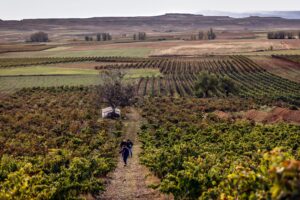
BRIONES. Bodegas Miguel Merino. Vinedo La Loma. 18.10.2024 Justo Rodriguez
At Davy’s, we are proud to work with small, family-owned producers who place quality, integrity and vineyard expression at the heart of everything they do. Miguel Merino is a perfect example of this philosophy. His long-term commitment to meticulous vineyard work and thoughtful winemaking has firmly established him as one of Rioja’s most respected producers.
We are delighted to share his 2026 harvest report below, written directly from Briones, offering a fascinating insight into their most recent vintage shaped by heat, rainfall and an exceptionally early harvest.
As Miguel’s UK distributor, we are pleased to present his own account of a challenging but ultimately rewarding vintage.
2026 Harvest Report (written by Miguel Merino Navajas)
In 2025, we wrote to you saying that we had experienced the earliest harvest in our history, starting to pick Tempranillo grapes on September 18th, of all dates. Well, this year we finished — yes, finished — our harvest on September 15th, and for the first
time in our history, we began harvesting in August.
What happened?
Winter started cold, and we even had some snow in November, although that was the last of it. The rest of the winter was mild and very rainy, and the beginning of spring was spectacularly wet, with relentless rain throughout March and April. The vines
began to bud with great vigour, but a cold and windy first half of May slowed this development and prevented any mildew problems. And that was the end of the cold weather.
The second half of May was very, very hot, and we had our first heatwave in June, with temperatures reaching 40°C and nights that never dropped below 22°C. We began to worry. In the vineyard, we avoided leaf removal and shoot thinning, with the clear aim
of keeping as much shade as possible. We also applied organic manganese and zinc treatments, along with seaweed extracts, to strengthen the vines’ resistance to heat and drought.
The heatwaves followed one another without respite, and only a few heavy storms at key moments — at the end of June, the end of July and in mid-August — made it possible for the vines to maintain good condition. However, this rainfall also helped the
plants accelerate the ripening of the grapes, which suddenly took off at the end of August.
Still unable to quite believe it, we began harvesting our white grapes on August 27th (Viura) and August 28th (Garnacha Blanca). On September 4th, we picked La Quinta Cruz, and on the 6th, La Loma. From there, we carried on without stopping, moving as quickly as we could, until we finished on the 15th.
The grapes came into the winery incredibly healthy and firm, with slightly high alcohol potential and somewhat low acidity. The musts are showing lots of fruit and an incredible colour. Fermentations are going well, although they are somewhat fast. We believe this is a year in which we need to be especially careful with extraction: we are fermenting at low temperatures, with very few pump-overs, and avoiding prolonged maceration.
We have always believed that the magic of Rioja Alta, beyond our soils, lies in the slow and gradual ripening of the grapes, due to the influence of the northerly wind that cools the afternoons and nights during our summers.
The vines here begin to bud at the same time as in the rest of the country, yet we harvest almost a month later. We believe that this is where the charm of our region lies, and the reason behind the fine, delicate character of our wines. If the 2026 wines turn out to be at the same level as in other years, we will have to ask ourselves some serious questions.
Of course, we also hope to be able to tell our future grandchildren that in 2026 we harvested in August, and that it will still be something difficult for the people of Rioja Alta to believe. We hope it will remain an anecdote, an exception, something to remember alongside the national football team’s second World Cup — and not a new reality.
Briones, September 26th, 2026

Davy's Wine Merchants
161-165 Greenwich High RoadGreenwich
London
SE10 8JA


Copyright © Davy’s 2008 ‐ 2026
Davy & Co Limited ‐ Registered in England: 129564, VAT number: 206 0019 24. Davy’s of London (Wine Merchants) Limited ‐ Registered in England: 963147. Mullins & Westley Ltd ‐ Registered in England: 380261.